People often imagine a psychic as someone staring into thin air, waiting for a message to drop out of nowhere. In practice, the work is less theatrical and more layered. A reading can draw on symbols, cards, a client’s words, the energy of the conversation, and the reader’s own intuition all at once.
That mix is exactly why the question matters. What psychics read depends on the style of the reader, the setting, and the tools on the table. Some rely on decks and spreads. Others lean on impressions, patterns, and the way a person frames a question.
More than one kind of information
When people ask what psychics read, they often want a clean, simple answer. Psychic work is usually a blend of inputs rather than a single source. A reading may include visual symbols, verbal cues, emotional tone, memories triggered by a question, and whatever the reader believes comes through intuitively.
Two sessions on the same topic can feel completely different. One reader may focus on tarot reading and the story the cards build. Another may say the client’s phrasing reveals the real issue before a card is even turned over. The reading becomes a conversation between the question, the tool, and the person giving the reading.
Symbols: the language behind the message
Symbols in psychic reading are not random decorations. They act like shorthand, pointing toward themes, tensions, timing, or emotional states. A symbol can come from a card image, a repeated number, a color, an animal, a location, or a scene that keeps appearing in the reader’s mind.
What matters is not just the image itself, but what it is doing in context. A ship might suggest distance, movement, or a transition. A closed door can imply delay or privacy, but it can also reflect a decision that has not been made yet. The same symbol can mean different things depending on the question and the surrounding details.
Experienced readers treat symbols less like code and more like clues. They do not stop at one image and call the case closed. They watch for patterns, repetition, and whether a symbol fits the emotional tone of the session. That is where the reading starts to feel less like guessing and more like interpreting.
Why symbols matter more than literal meaning
Symbolic language gives a reading room to breathe. If every image had only one fixed meaning, the work would be rigid and flat. Symbols allow for nuance, which matters when the question is personal and emotionally loaded.
Take a rose, for example. It may suggest affection, beauty, or a relationship issue, but it might also point to something delicate that needs careful handling. In some readings, the presence of a thorn matters more than the flower itself. The message is rarely just “love” or “yes” or “no.” It is usually about the shape that love, fear, or timing is taking right now.
Cards as a structured way to read a story
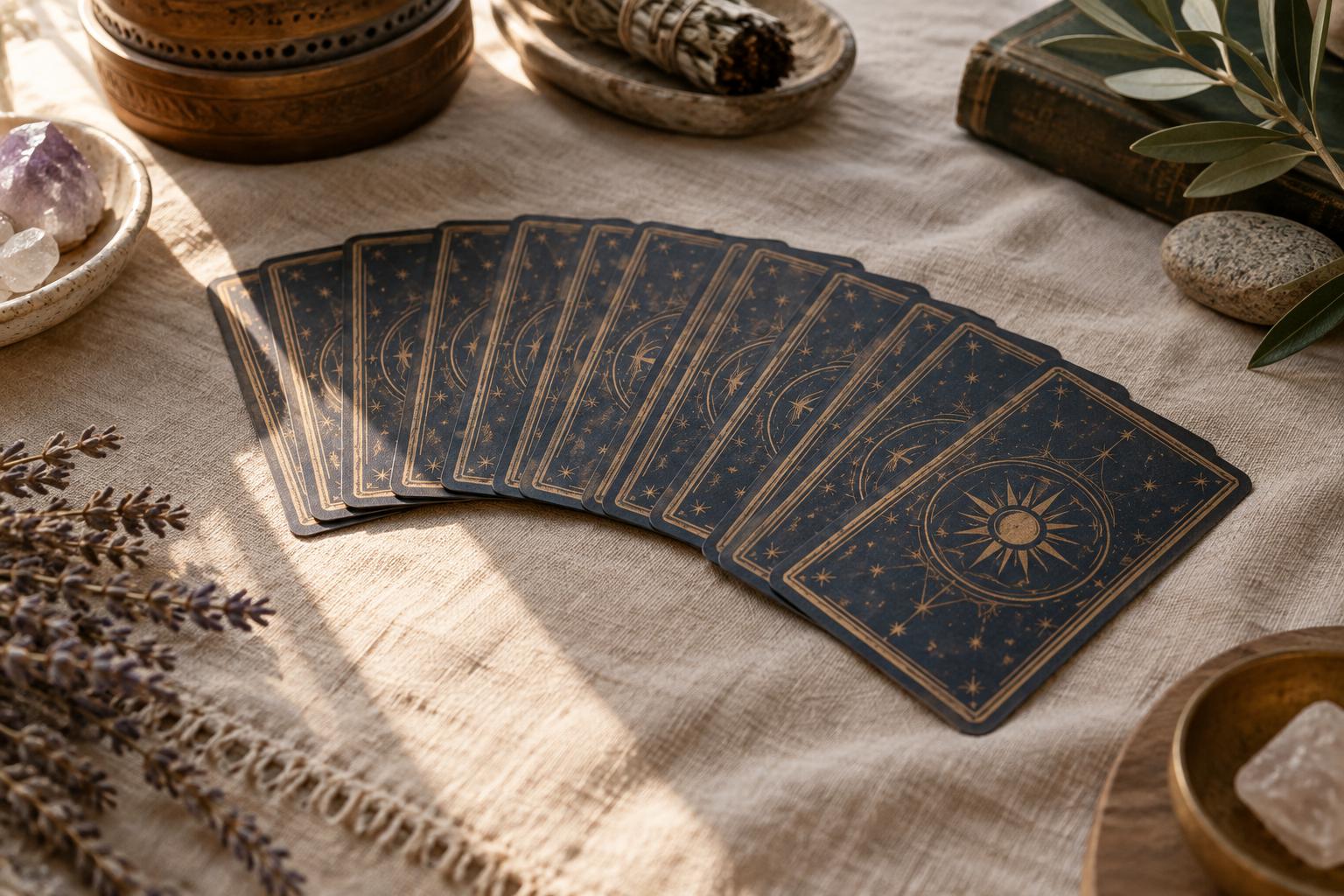
Cards are one of the most familiar psychic reading tools, and for good reason. They provide visible structure that helps organize impressions. In tarot reading, the deck offers a vocabulary of images, numbers, suits, and archetypes that can be arranged into a meaningful sequence.
This is why people often find card readings easier to follow than purely intuitive work. The cards give the session a spine. A spread can show a starting point, a challenge, hidden influences, possible outcomes, and practical advice. Even a highly intuitive reader uses the cards to anchor the reading in something the client can see.
A seven of swords might raise concerns about honesty. A wheel of fortune may shift the tone toward change and timing. The card does not carry a fixed fate. It invites a certain line of interpretation.
How a spread shapes the message
The layout matters as much as the cards themselves. A single card pulled for guidance may produce a broad message, while a five-card spread can reveal tension between different parts of a situation. Position changes meaning. The same card in a “challenge” spot reads differently than in an “outcome” spot.
That structure is useful because human problems rarely come in neat packages. Someone asking about a relationship may not only want to know whether it will last. They may want clarity on timing, commitment, communication, or whether the issue is really about the relationship at all. A spread teases those layers apart without forcing a simplistic answer.
Intuition: the quiet engine behind the reading
Intuition reading is harder to pin down, partly because it does not always look dramatic from the outside. It may show up as a sudden certainty, a visual flash, a sentence that lands in the reader’s mind, or a physical sensation connected to the question. Some readers describe it as receiving rather than inventing.
Whether one accepts that explanation literally or not, intuition plays a central role in many psychic sessions. It helps a reader decide which symbol matters, when a card is emphasizing a warning rather than a possibility, and when a client is asking one question while carrying another underneath it. Without intuition, the reading becomes mechanical very quickly.
That does not mean intuition is shorthand for accuracy. A good reader tests impressions against the rest of the reading. If a feeling appears out of nowhere but does not fit the cards, the language, or the person’s situation, it may be noise rather than signal. Intuition is useful, but it is not self-certifying.
How do psychics read people in practice?
This is where the craft becomes especially interesting. How do psychics read people is not a mystery with a single answer. They may notice micro-expressions, posture, hesitations, emotional energy, and the kinds of words a client chooses. Those observations blend with intuitive impressions and the structure of the reading itself.
Sometimes a client gives away far more than they realize. A person asking about a job but repeatedly returning to fear of conflict may be revealing the real issue: they are worried about speaking up. Skilled readers listen for that kind of shift. The question on the surface is not always the question underneath.
This is one reason psychic reading methods can seem uncannily precise. A reader may not be pulling information from nowhere. They may be combining attentive listening with pattern recognition and a practiced sensitivity to what is unsaid.
If you have never had a session before, it helps to know
what a psychic actually does during a reading so you can separate intuition from performance.
Personal questions are usually the real doorway

The most revealing readings tend to begin with personal questions, not generic ones. “Will I be happy?” is much harder to work with than “Why do I keep feeling stuck in this relationship?” The second question gives shape, context, and a direction for interpretation.
Specific questions also help the reader decide which psychic reading tools are most useful. A question about timing may lean well toward cards, while a question about a repeating emotional pattern may call for a more reflective, intuitive style. The more grounded the question, the more grounded the reading can be.
A client does not need to know everything before starting. Many people seek a reading because they are confused. Even a rough but honest question is more valuable than a polished one that avoids the real issue. A good reader can work with uncertainty. They cannot do much with vagueness that hides the heart of the matter.
What strong questions usually have in common
- They are specific enough to explore.
- They focus on the client’s real concern, not just the most polite version of it.
- They leave room for explanation, not only a yes-or-no answer.
- They are about a situation the client can actually influence.
A question like “What do I need to understand about this move?” opens a broader and more useful reading than “Will this work out?” The first invites insight. The second can trap both reader and client into waiting for a verdict that may be too small for the situation.
The different psychic reading methods readers actually use

Psychic reading methods vary widely, and the differences matter. Some readers work with tarot or oracle cards. Others use pendulums, crystals, runes, tea leaves, palm lines, astrology, or direct intuitive impressions. Many mix several approaches rather than sticking to one label.
Each method changes the feel of the reading. Cards offer structure. Astrology brings timing and larger cycles into view. Runes can feel stark and concentrated. Purely intuitive work can be fluid, personal, and difficult to verify in a neat way. The tool shapes the kind of information the reader can emphasize.
Tools are not the same thing as the reading itself. A deck does not speak on its own. A crystal ball does not contain a script. The tool gives the reader a surface to work from, much like a microphone gives a voice volume without creating the words.
| Tool |
What it helps with |
Typical strength |
| Tarot cards |
Themes, choices, timing, relationships |
Structured interpretation |
| Oracle cards |
Broad guidance, emotional focus |
Flexible messaging |
| Runes |
Direct, symbolic insight |
Concise symbolism |
| Pendulum |
Simple directional answers |
Clear yes/no format |
| Astrology |
Cycles, timing, tendencies |
Longer-range context |
No tool removes the need for interpretation. Even the most visible object in the room only becomes meaningful through attention and context. Two readers using the same cards can produce very different sessions. They are not reading the paper. They are reading the patterns that emerge through the paper.
If you want a broader view of how these styles fit together, see
what a psychic is and how different reading styles function.
How do psychics get information?
People ask how do psychics get information because the process can seem hidden. There is no universally accepted explanation. Believers may describe it as receiving impressions from spirit, energy, or an intuitive source. Skeptics may point to observation, suggestion, and skilled inference.
Whatever explanation a reader uses, the process usually has a few visible parts. First comes attention. Then comes a cue of some kind, whether it is a card image, a feeling, a word, or a pattern. After that comes interpretation, where the reader decides what matters and how to explain it in plain language.
Information in a reading is not usually dumped out all at once. It arrives in pieces. A reader notices one detail, tests it against the question, then decides whether to follow it. This back-and-forth creates the sense that the reading is unfolding rather than being recited.
Some readers talk about energy because that is the language they trust. Others describe “seeing,” “hearing,” or “knowing.” Many simply say they pick up on patterns. These descriptions can sound very different, but they may point to overlapping experiences.
The vocabulary matters less than the discipline behind it. A responsible reader knows the difference between a strong impression and a flashy guess. They know when to speak plainly and when to leave room for uncertainty. That restraint often makes the reading more useful than dramatic certainty ever could.
If the distinction between channels interests you, it helps to know how
psychic and clairvoyant abilities compare in practice.
Reading symbols without turning them into a script
Symbols are powerful, but they become a trap if treated too literally. A house does not always mean home life, and a key does not automatically mean a solution. The surrounding context decides how much weight a symbol carries.
In good hands, symbols in psychic reading work like a conversation starter. They invite the reader to ask, “What is this pointing toward?” rather than “What does this always mean?” That shift keeps the reading alive. It prevents the session from becoming a matching game where every image is forced into a fixed box.
Clients often appreciate this flexibility once they hear it explained. It feels more honest. A symbol can suggest several things at once, and the reader’s job is to narrow the field, not pretend the field never existed.
Tarot reading and the art of pattern recognition
Tarot reading sits at the crossroads of structure and intuition. Each card carries a familiar image, but the meaning changes depending on the spread, the question, and the surrounding cards. That makes tarot both accessible and demanding.
A novice may see a single card and assume it has one message. A more experienced reader sees relationships. The cup next to the sword, the tower beside the star, the repeated numbers across the spread, the direction of movement from one position to another. These details build a sentence out of images. The reading lives in the pattern, not the isolated card.
Personal questions make a real difference here. A spread about career may emphasize conflict, expansion, or caution very differently than a spread about grief or a family dispute. Tarot is not just about symbols. It is about how symbols behave together under pressure.
Tarot often feels precise because it can mirror the emotional architecture of a situation. A client hears a message about choice, resistance, or change and recognizes their own life in it almost immediately. That recognition can be startling, especially when the reader names something the client has been circling around silently.
Tarot is not a surveillance device. It does not report hidden facts like a camera. It works best when it reveals the shape of an issue, the forces around it, and the choices still available. That kind of clarity can be more useful than a blunt prediction anyway.
What clients bring into the reading
A reading is never one-sided. The client brings history, hope, fear, and expectations into the room, and those things shape the session. Even before the first card is drawn, the reader is already responding to tone, pacing, and the way the question is asked.
Different clients can receive different experiences from the same reader on the same topic. Someone who asks from panic may hear a very different emphasis than someone who asks from curiosity. The information may be similar, but the framing changes what lands and what gets ignored.
Good readers stay aware of this. They do not let the client’s anxiety run the whole session, but they also do not pretend the anxiety is irrelevant. In a real reading, the emotional climate is part of the material.
Skilled readers also pick up on less visible material. They may notice pacing in speech, recurring worries, unspoken assumptions, or the difference between what a person says and what they seem to mean.
That is especially true in live readings, where the conversation itself becomes part of the evidence. A client may insist they want advice about a new job while repeatedly circling back to a former partner. A reader does not need to be theatrical to notice that the real wound may be elsewhere. Sometimes the most helpful reading begins the moment the question stops pretending to be simpler than it is.
This does not mean psychics are mind readers in the comic-book sense. It means they are often attentive in a way that makes hidden patterns easier to spot. Attention, language, symbolism, and intuition combine into a reading that can feel remarkably accurate when it lands cleanly.
Limits, uncertainty, and the value of staying honest
A credible psychic reading acknowledges uncertainty. Not every symbol is loud. Not every question opens easily. Not every impression turns out to matter. Readers who admit that tend to earn more trust than those who act as if every sentence came with a guarantee.
This honesty also protects the client. A reading should help someone think more clearly, not lock them into a single interpretation they cannot test. The best sessions leave room for reflection. They offer a lens, not a prison.
There is also a practical limit to what any reading can do. It cannot force another person’s choices. It cannot replace medical, legal, or financial advice. It can illuminate possibilities, patterns, and blind spots, but it is still one source of perspective among many.
How to make a reading more useful
If the goal is clarity, the client can help the process along. The strongest readings often come from calm, direct questions and a willingness to hear more than one layer of meaning. A person who listens for themes rather than perfect predictions usually gets more from the session.
That last point is important. A good reading should create some combination of clarity, recognition, and useful tension. It may not deliver the exact answer someone hoped for, but it should give them something real to work with. If it does not, the issue may be the reader, the question, or the fit between the two.
Once you have a sense of which style suits you, the next step is learning
how to find a psychic reader you can trust without wasting money on the wrong match.
When symbols, cards, and intuition work together
The most compelling readings often happen when all the elements line up. A card shows a symbol, the symbol sparks an intuitive response, and the client’s question gives both a place to land. The result can be surprisingly coherent, almost as if several instruments were playing the same tune from different angles.
That coherence is what people usually remember. Not the technical details. Not the deck name or the exact spread. They remember the moment when the reading described a truth they had not fully named yet. It might be about hesitation, grief, ambition, distance, or a decision that has been quietly waiting in the background.
So when someone asks what psychics read, the honest answer is not a single item on a list. They read patterns. They read symbols. They read the structure created by tarot reading or other psychic reading tools. They read the client’s question, the unspoken context around it, and whatever intuition reading brings into focus. When the session is working, those pieces line up just enough to make the next step easier to see.
Related reading