11 Akashic Records books checked against publisher listings, grouped into method books, Edgar Cayce and theory, with a reading order for beginners.

Best Akashic Records Books: 11 Verified Picks and Where to Start

The best Akashic Records books fall into three camps: hands-on method books that teach a prayer for opening the Records, books built on Edgar Cayce’s readings, and big-picture books that treat the Akashic field as philosophy or science. Pick the wrong camp and you’ll be bored or lost by chapter two. Below are 11 books we verified against publisher and library listings, grouped by what they actually teach, with a short reading order for beginners.
Quick picks. First book for most people: How to Read the Akashic Records by Linda Howe (Sounds True, 2009). Lightest introduction: The Beginner’s Guide to the Akashic Records by Whitney Jefferson Evans (Adams Media, 2021). The Cayce angle: Edgar Cayce on the Akashic Records by Kevin J. Todeschi (A.R.E. Press, 1998). The theory book: Science and the Akashic Field by Ervin Laszlo (Inner Traditions, 2004).
Contents
What these books are about
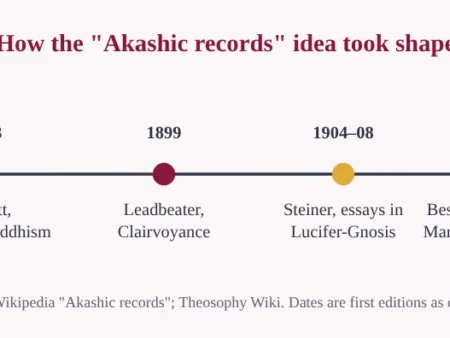
Ākāśa is a Sanskrit word usually translated as “ether,” “sky” or “space.” Britannica describes the Akashic records in occult tradition as pictorial records imprinted on that ether, a kind of cosmic memory of everything that has happened. The idea entered Western esotericism through Theosophy in the late 1800s: Helena Blavatsky wrote about the “astral light,” A. P. Sinnett’s Esoteric Buddhism (1883) spread the concept, and C. W. Leadbeater’s Clairvoyance (1899) described the records as something a clairvoyant could read. Rudolf Steiner and later Edgar Cayce made it famous.
One honest note before the list. There’s no scientific evidence that the Akashic Records exist outside personal accounts. The books below are spiritual practice and philosophy. Read them the way you’d read a book on meditation or prayer, as a method someone found meaningful, not as documented fact.
If you’re new to the concept itself, start with our guide on how to access the Akashic Records, which covers the prayer methods and what a session looks like. This page is just about the books.
All 11 books at a glance
| Book | Author | Publisher, year | Type | Best for |
|---|---|---|---|---|
| How to Read the Akashic Records | Linda Howe | Sounds True, 2009 | Method (Pathway Prayer) | First practical book |
| Discover Your Soul’s Path Through the Akashic Records | Linda Howe | Hay House (paperback 2015) | Method + soul purpose | Life-direction questions |
| Healing Through the Akashic Records | Linda Howe | Sounds True, 2016 | Method + healing | Working with old wounds |
| The Infinite Wisdom of the Akashic Records | Lisa Barnett | New Page Books, 2015 | Method (five-step prayer) | Structured, step-by-step learners |
| The Akashic Records | Ernesto Ortiz | New Page Books, 2014 | Method + shamanic healing | Energy-work practitioners |
| Opening the Akashic Records | Maureen J. St. Germain | Bear & Company, 2019 | Method (Higher Self protocol) | Reading for others |
| The Akashic Records Made Easy | Sandra Anne Taylor | Hay House UK, 2018 | Beginner overview | Past lives and timelines |
| The Beginner’s Guide to the Akashic Records | Whitney Jefferson Evans | Adams Media, 2021 | Beginner overview | Absolute beginners |
| Edgar Cayce on the Akashic Records | Kevin J. Todeschi | A.R.E. Press, 1998 | Cayce readings | Cayce readers, karma |
| The New Akashic Records | Cheryl Marlene | Soul Bright Press, 3rd ed. 2021 | History and theory | Deep study |
| Science and the Akashic Field | Ervin Laszlo | Inner Traditions, 2004 (2nd ed. 2007) | Philosophy and science | Skeptical or analytical readers |
Years are first publication of the edition we could verify. Some titles have later editions with new ISBNs.
Method books: learning to open the Records
These six books teach a specific technique, nearly always an opening prayer followed by questions and a closing. They differ in how strict the method is and what they use the Records for.
1. How to Read the Akashic Records, Linda Howe
Sounds True, 2009 · about 180–208 pages depending on edition
This is the book most other Akashic teachers get compared to. Howe teaches the Pathway Prayer Process, set out in Chapter 3 and repeated in condensed form in the appendix, so you can work from the book without flipping around. The second half moves from opening the Records to using them, with chapters on energy healing, ancestral patterns and past lives.
Why we’d start here: the method is strict. A specific prayer, read in a set way, with guidance on what to do when nothing seems to happen. Beginners usually need that structure more than inspiration.
2. Discover Your Soul’s Path Through the Akashic Records, Linda Howe
Hay House · 232 pages (paperback, 2015)
Howe’s follow-up turns the method toward one big question: what you’re here to do. She frames the Records as a personal chronicle and uses them to look at purpose, patterns and choices. Read it after book one, not instead of it; it assumes you can already open the Records.
3. Healing Through the Akashic Records, Linda Howe
Sounds True, 2016 · 272 pages
The third Howe book is built around a three-step healing process and the idea of a central “sacred wound.” Expect exercises about limiting beliefs and recurring life patterns. It suits readers who come to the Records for emotional work rather than curiosity about past lives.
4. The Infinite Wisdom of the Akashic Records, Lisa Barnett
New Page Books / Red Wheel Weiser, March 2015 · 192 pages
Barnett teaches a five-step prayer system with three “vibrational keys,” and spends real time on how to phrase questions, which is where many beginners go wrong. Later chapters cover karma, soul contracts and vows. If Howe’s book feels too dense, this is the most practical alternative.
5. The Akashic Records, Ernesto Ortiz
New Page Books, 2014
Ortiz writes as a shamanic healer, and it shows. Alongside a sacred opening prayer, he covers working with the “Lords of Akasha,” combining the Records with other healing modalities and protection practices. It’s the best fit for people who already do energy work and want to fold the Records into it.
6. Opening the Akashic Records, Maureen J. St. Germain
Bear & Company (Inner Traditions), April 2019 · 176 pages
St. Germain’s protocol connects through your Higher Self and the Record Keepers rather than a single fixed prayer. She also covers how to check what you receive and how to open records for other people. That last part makes it the most useful book here if you’re thinking about offering readings.
Edgar Cayce and the “Book of Life”
7. Edgar Cayce on the Akashic Records, Kevin J. Todeschi
A.R.E. Press, 1998 · 181 pages
Edgar Cayce (1877–1945) gave thousands of trance readings and said he drew on what he called the Book of Life. Todeschi, long associated with Cayce’s organization, the Association for Research and Enlightenment, explains the concept through those readings. It’s not a how-to book. It’s the best single source if you want to know what Cayce himself claimed about the Records, karma and reincarnation.
Many people searching for “Edgar Cayce Akashic Records” want exactly this. If you read only one Cayce book on the subject, make it this one.
History, theory and science
8. The New Akashic Records, Cheryl Marlene
Soul Bright Press, 3rd edition 2021 · 544 pages
At 544 pages this is the heavyweight. Marlene treats the Records as a spiritual practice with a long intellectual history, from ancient sources to modern physics. Her retailer describes it as not a how-to guide, and that’s accurate. Get it once you’ve practiced for a while and want to understand what you’re doing.
9. Science and the Akashic Field, Ervin Laszlo
Inner Traditions, 2004 · 205 pages (2nd edition 2007, 208 pages)
Laszlo, a philosopher of science, argues for a universal information field linked to the quantum vacuum, drawing on physics, cosmology, biology and consciousness research. There’s no prayer and no reading method. Read it if you’re analytically minded, and read it critically: it’s a speculative theory, not established physics.
Beginner overviews
10. The Akashic Records Made Easy, Sandra Anne Taylor
Hay House UK, July 2018 · 272 pages
A friendly overview of what the Records are said to hold, how to access them, past-life influences and timelines, with a section on using the Records for planning. It first appeared under the shorter title The Akashic Records in Hay House’s Basics series, so don’t buy both by mistake.
11. The Beginner’s Guide to the Akashic Records, Whitney Jefferson Evans
Adams Media (Simon & Schuster), January 2021 · 208 pages
The lightest book on the list. Evans presents the Records as a soul’s library and walks through what they are, how to trace your soul’s history and what she calls astral destinations. Good as a gift or a first taste; you’ll probably want a method book afterward.
Which book to read first
Choose by what you want out of the Records, not by star ratings.
| If you want to… | Start with | Then read |
|---|---|---|
| Learn to open your own Records | Howe, How to Read the Akashic Records | Barnett, The Infinite Wisdom of the Akashic Records |
| Just understand the idea | Evans, The Beginner’s Guide | Taylor, The Akashic Records Made Easy |
| Explore past lives | Taylor, The Akashic Records Made Easy | Howe, How to Read the Akashic Records (Part 2) |
| Read for clients or friends | St. Germain, Opening the Akashic Records | Howe, Discover Your Soul’s Path |
| Follow Edgar Cayce | Todeschi, Edgar Cayce on the Akashic Records | Howe, for a practical method |
| Question the whole concept | Laszlo, Science and the Akashic Field | Marlene, The New Akashic Records |
Our pick for most readers: Howe first, Barnett second. Two different prayer systems show you what’s essential to the practice and what’s one teacher’s style. Skip the theory books until you’ve done at least a few sessions; they make more sense once you have your own experience to compare.
How to get the most out of a method book
Reading a method book cover to cover and never doing the exercises is the most common mistake. A few habits make a real difference.
Pick one method and stick with it for a month. Switching prayers every few days makes it impossible to tell what’s working. Keep a notebook for every session: the date, your question, what came through and how you felt afterward. After four weeks, patterns are easier to see.
Write your questions before you open the Records. Both Howe and Barnett put weight on question phrasing, and “What do I need to understand about my work right now?” usually gets further than “Will I get promoted?” Our guide to what to ask a psychic covers the same principle for readings.
Many readers also link Akashic work with past-life exploration. If that’s your interest, our past life reading guide and the piece on connecting with spirit guides pair well with these books.
Be careful with paid “Akashic readings” that come with pressure: warnings about blocked records, curses, or a reading that is “incomplete” without another payment. Those are classic warning signs, covered in our psychic scams guide. A good book teaches you to do the work yourself.
FAQ
What is the best book on the Akashic Records for beginners?
For learning a method, How to Read the Akashic Records by Linda Howe (Sounds True, 2009) is the usual first choice. For a light introduction with no strict method, try The Beginner’s Guide to the Akashic Records by Whitney Jefferson Evans (Adams Media, 2021).
What is the Pathway Prayer?
It’s the opening prayer at the core of Linda Howe’s method. Her book How to Read the Akashic Records teaches it in Chapter 3 and repeats it in condensed form in the appendix.
Did Edgar Cayce write a book about the Akashic Records?
Cayce didn’t write one himself; his trance readings were recorded. Kevin J. Todeschi’s Edgar Cayce on the Akashic Records (A.R.E. Press, 1998) collects and explains what those readings say about the Book of Life.
Is there scientific evidence for the Akashic Records?
No. Apart from personal accounts, there’s no evidence the Records exist. Ervin Laszlo’s Science and the Akashic Field proposes a theory linked to the quantum vacuum, but it’s speculative philosophy, not accepted physics.
Where does the term Akashic Records come from?
Akasha is a Sanskrit word for ether or space. The idea of records stored in it was developed by Theosophists in the late 1800s, including Helena Blavatsky, A. P. Sinnett and C. W. Leadbeater, and later popularized by Rudolf Steiner and Edgar Cayce.
Can I learn to read the Akashic Records from a book alone?
Many people start that way. Method books by Linda Howe, Lisa Barnett and Maureen St. Germain give full step-by-step processes. Practicing regularly and keeping a journal matters more than which book you choose.
Which Akashic Records book is best for reading for other people?
Opening the Akashic Records by Maureen J. St. Germain (Bear & Company, 2019) includes guidance on opening records for others and on checking the information you receive.

© 2026 bestonlinepsychic.org | Privacy Policy | Terms
We may earn a commission when you use our links. This does not affect our ratings.