Five career tarot spreads (stay or go, will I get the job, two offers), the 15 strongest career cards upright and reversed, a sample reading, and free online tools vs. a live reader.

Career Tarot Reading: 5 Spreads, Key Cards and a Sample Reading

A career tarot reading uses the cards to look at work questions: whether to stay or leave, how a job search is going, what’s blocking a promotion, which of two offers fits you better. This guide gives you five career spreads you can lay out tonight, the cards that carry the strongest work meanings (including the reversed ones people panic about), a sample reading walked through card by card, and an honest look at what a free online career reading can and can’t tell you.
Quick version. For a career question, use a spread with a position for what you bring, what’s in the way and the next step. Pentacles describe money and practical work, Wands ambition and energy, Swords decisions and conflict, Cups satisfaction and team relationships. Read the cards as a prompt for planning, not a forecast of whether HR will call back.
Contents
What a career tarot reading can (and can’t) do
Tarot is good at one thing in a career context. It forces you to look at a situation from angles you’ve been avoiding. Pull the Five of Pentacles in the “what’s in the way” position and you’ll have to ask yourself whether money fear, not the job itself, is what keeps you stuck. That’s useful.
What tarot can’t do is report facts you don’t have. The cards won’t tell you whether a hiring manager liked your interview, whether layoffs are coming, or what salary to ask for. For those questions you need information: salary data, a conversation with your manager, a recruiter’s honest feedback. Use the reading to decide what to find out and what to do next.
There’s no scientific evidence that tarot predicts events. We say that once, here, and then get on with the practical part.
How each suit speaks about work
The Minor Arcana splits into four suits of 14 cards. In a work reading, each suit points to a different side of your professional life.
| Suit | Element | Career themes | Shows up a lot when… |
|---|---|---|---|
| Pentacles | Earth | Money, skills, stability, the actual work you produce | The question is about pay, security, a business or craft |
| Wands | Fire | Ambition, drive, new projects, leadership, burnout | You’re starting something, competing, or running out of steam |
| Swords | Air | Decisions, communication, conflict, stress, office politics | There’s a tough choice, a difficult boss or a conflict |
| Cups | Water | Job satisfaction, teamwork, meaning, emotional fit | The job looks fine on paper but feels wrong |
A spread dominated by one suit is a message in itself. All Swords and no Cups? You may be treating an emotional decision as a purely logical one. Lots of Major Arcana cards usually mean the change is bigger than one job: a whole direction is shifting.
The 15 strongest career cards
Any card can appear in a work reading. These are the ones with the clearest professional meaning, upright and reversed.
| Card | Upright (career) | Reversed (career) |
|---|---|---|
| The Magician | You have the skills; time to pitch, launch, apply | Overpromising, or not using what you’ve got |
| The Empress | Creative work that grows, a project that thrives with care | Creative block, neglecting your own work |
| The Emperor | Structure, a strong manager, taking a leadership role | A controlling boss, rigid rules |
| The Chariot | Drive and focus win; a competitive push pays off | Pulling in two directions, losing control of a project |
| Wheel of Fortune | A change of circumstances, often outside your control | A delay or setback that won’t last forever |
| Death | A role or chapter ends so another can start | Hanging on to a job you’ve outgrown |
| The Tower | Sudden change: restructuring, a shock, a forced rethink | Seeing the crack early and acting before it breaks |
| The Sun | Success, recognition, a good fit | Success delayed, or not enjoying it |
| Ace of Pentacles | A new job offer, contract or income source | An offer that falls through, poor planning |
| Three of Pentacles | Teamwork, being valued for your skill | Poor collaboration, credit taken by others |
| Eight of Pentacles | Learning, apprenticeship, getting really good at something | Perfectionism, or boredom with repetitive work |
| Ten of Pentacles | Long-term security, family business, legacy | Instability in finances or a family firm |
| Three of Wands | Expansion, looking outward, a job in another city or market | Plans not taking off, waiting too long |
| Eight of Cups | Walking away from something that no longer fulfils you | Fear of leaving, or leaving for the wrong reason |
| Ten of Wands | Overload, carrying too much | Dropping some of the load, delegating |
A note on Death and The Tower, since they scare people. In a career spread neither one means anything bad will happen to you physically. Death is about endings; The Tower is about sudden change. Both often turn up just before a job change that later feels obviously right.
5 career tarot spreads
Shuffle while thinking about your question, then lay the cards out in order. If you’re new to the deck, our tarot for beginners guide covers shuffling and reversals.
1. One-card daily career pull
Ask “What do I need to focus on at work today?” and draw one card. It takes 30 seconds and builds your vocabulary with the deck faster than anything else. Write the card down; after a month, look at which suits kept appearing.
2. Three-card “stay or go”
Position 1: what staying looks like. Position 2: what leaving looks like. Position 3: what you’re not seeing. That third card is usually the one people end up talking about.
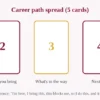
3. Five-card career path (diagram above)
Where you are, what you bring, what’s in the way, next step, likely direction. This is the most useful general-purpose work spread and the one we’d start with for questions like “Where is my career heading?”
4. “Will I get the job?” spread (4 cards)
Position 1: how you came across. Position 2: what the employer needs. Position 3: what you can still do. Position 4: likely outcome. Positions 1 to 3 are where the value is. If card 3 is the Page of Swords, send that follow-up email. If card 4 disappoints you, remember you’ve learned nothing the employer hasn’t decided yet.
5. Two offers, side by side (6 cards)
Lay two columns of three: for each job, “what it offers,” “what it costs you,” “how you’ll feel in a year.” Compare across the rows rather than reading each column alone. This works well alongside a plain spreadsheet of salary, commute and growth.
| Spread | Cards | Best for | Time |
|---|---|---|---|
| Daily pull | 1 | Habit, daily focus | 1 min |
| Stay or go | 3 | Thinking about quitting | 5–10 min |
| Career path | 5 | Overall direction | 15–20 min |
| Will I get the job? | 4 | After an interview or application | 10 min |
| Two offers | 6 | Choosing between jobs | 20 min |
A sample reading, step by step
To show how the pieces fit, here’s an illustrative reading. It’s a constructed example, not a real client session.
Question: “Where is my career heading over the next six months?” (career path spread)
- Where you are, Ten of Wands. Overloaded. Too many projects, probably some that aren’t yours.
- What you bring, Eight of Pentacles. Real skill built through repetition. People rely on your work quality.
- What’s in the way, The Emperor reversed. A rigid structure or a manager who controls rather than supports, or your own reluctance to set boundaries.
- Next step, Three of Wands. Look outward. Update your portfolio, talk to people outside the company, see what’s out there.
- Likely direction, Ace of Pentacles. A new opportunity with a practical, financial upside.
Put together: “I’m overloaded, I’m good at what I do, the structure (or my lack of boundaries) is the problem, so I start looking outward, and that tends toward a new offer.” The reading doesn’t tell you a new job is guaranteed. It tells you the next action is to start looking, and to think about delegation in the meantime. That’s a plan you can test.
How to phrase career questions
Open questions get readable answers. Yes/no questions get anxiety. Compare:
| Instead of… | Try… |
|---|---|
| Will I get promoted? | What would make me a stronger candidate for promotion? |
| Should I quit? | What am I not seeing about staying versus leaving? |
| Does my boss hate me? | How can I improve my working relationship with my manager? |
| Will my business succeed? | What’s my biggest blind spot in this business right now? |
| When will I find a job? | What should I change in my job search? |
More examples of well-built questions are in our guide on what to ask a psychic.
Free online career readings vs. a live reader
Search “free career tarot reading” and you’ll find dozens of card-flip tools. They draw random cards and show a stock meaning. That’s fine for learning card meanings or for a quick prompt, and we’d use them that way. They can’t respond to your situation, ask follow-up questions or notice that you flinched at the word “manager.”
A live reader can. If you go that route, choose one who records the session, lists prices up front and doesn’t push packages. Platforms differ a lot in pricing and screening; see our comparison of psychic reading apps and our breakdown of reading costs before booking. We haven’t tested every career specialist on every platform, so read recent reviews yourself.
| Free online tool | Self-reading with a deck | Live reader | |
|---|---|---|---|
| Cost | Free | Price of a deck | Per minute or per session |
| Personal context | None | Full, but you’re biased | Full, outside view |
| Follow-up questions | No | Yes | Yes |
| Best use | Learning meanings | Regular reflection | Big decisions, fresh perspective |
Watch out for readers who tell you to quit, take a loan or invest based on the cards, or who say a “block” on your career can be removed for a fee. Real career decisions need real information. Our psychic scams guide lists the common tricks.
How to use the reading afterwards
A career reading earns its keep only if it changes what you do on Monday. Within 24 hours, write down three things: the card that bothered you most, the one action the reading suggests, and the piece of real information you need before acting (a salary range, a conversation, a job listing). Then do the action.
Repeat the same spread in four to six weeks. If the “what’s in the way” card has changed, something has shifted. If it hasn’t, that’s worth noticing too. Honestly, the readers who get the most out of career tarot treat it like a journaling prompt with pictures, and it works well in that role.
If you like card work, two related guides on this site are worth a look: how to read oracle cards, which suit gentler, open-ended questions, and life path numbers, which many readers combine with tarot for career questions.
FAQ
What is a career tarot reading?
A tarot reading focused on work questions such as job changes, promotions, job searches or a business. It uses spreads with positions for your current situation, strengths, obstacles and next steps.
Which tarot card means a new job?
The Ace of Pentacles is the classic new-job or new-income card. The Three of Wands points to expansion or opportunities further afield, and the Wheel of Fortune to a change in circumstances.
What is the best tarot spread for career?
For most questions, a five-card career path spread: where you are, what you bring, what’s in the way, next step and likely direction. For a choice between offers, use two columns of three cards.
Can tarot tell me if I’ll get the job?
No reading can know a decision the employer hasn’t shared. A “will I get the job” spread is more useful for showing how you came across and what you can still do, such as a follow-up.
Is a free career tarot reading accurate?
Free online tools draw random cards and show stock meanings, so they can’t account for your situation. They’re useful for learning card meanings or as a quick prompt, not for big decisions.
Is the Death card bad in a career reading?
No. In a work context Death usually means one role or chapter is ending so another can start. It often appears before a job change that later feels right.
How often should I do a career reading?
A one-card daily pull is fine as a habit. For bigger spreads, every four to six weeks is enough to see whether anything has changed without chasing reassurance.
Should I make career decisions based on tarot?
Use tarot to decide what to think about and what to find out, then base the decision on real information such as salary data, conversations and the job itself.



© 2026 bestonlinepsychic.org | Privacy Policy | Terms
We may earn a commission when you use our links. This does not affect our ratings.