


People turn to clairvoyant readings for all kinds of reasons. Some are looking for comfort after a loss, some want a fresh angle on a relationship or job decision, and others are simply curious about what a clairvoyant reader says they can perceive.
The idea has a long cultural reach, but the specifics can be hard to pin down. Practitioners describe their work in many different ways, and the language around it can sound mysterious even when the service itself is fairly simple: a conversation, an impression, and a set of interpretations offered in real time.
If the terms themselves still feel fuzzy, it helps to start with how psychic and clairvoyant terms compare.
The basic idea behind the practice
At its core, clairvoyant readings are presented as a form of intuitive insight. A practitioner says they receive information through impressions, images, symbols, or a strong sense of knowing that is not based only on ordinary observation. For believers, that is the heart of the appeal.
If you ask what is a clairvoyant reading, the most practical answer is this: it is a session in which a reader says they can perceive details about a person, situation, or possible direction in life through extrasensory impressions. The details may come as visuals, words, or sensations, and the reader then interprets them for the client.
Different practitioners describe the process differently. One may focus on life patterns, another on emotional blockages, and another on specific questions about love, work, or family. That variety is one reason the topic can be hard to define in a single sentence.
What practitioners say they actually do
Ask a seasoned clairvoyant reader what they do during a session, and the answer is rarely theatrical. Most describe a calm exchange in which they tune in, listen carefully, and relay impressions as they arise. They may use silence, notes, symbols, or a gentle back-and-forth with the client.
What clairvoyants offer, according to their own descriptions, is not usually certainty in the ordinary sense. Instead, they say they provide perspective, possible patterns, and intuitive guidance. Some frame the work as helping clients notice what they already sense but have not yet put into words.
That distinction matters. A practitioner may not claim to control outcomes or guarantee exact events. More often, the pitch is about clarity, timing, and the emotional shape of a situation. In that sense, the reading is less like a verdict and more like a lens.
To see how that lens is actually used during a session, see what a psychic does during a reading.
How a session often unfolds
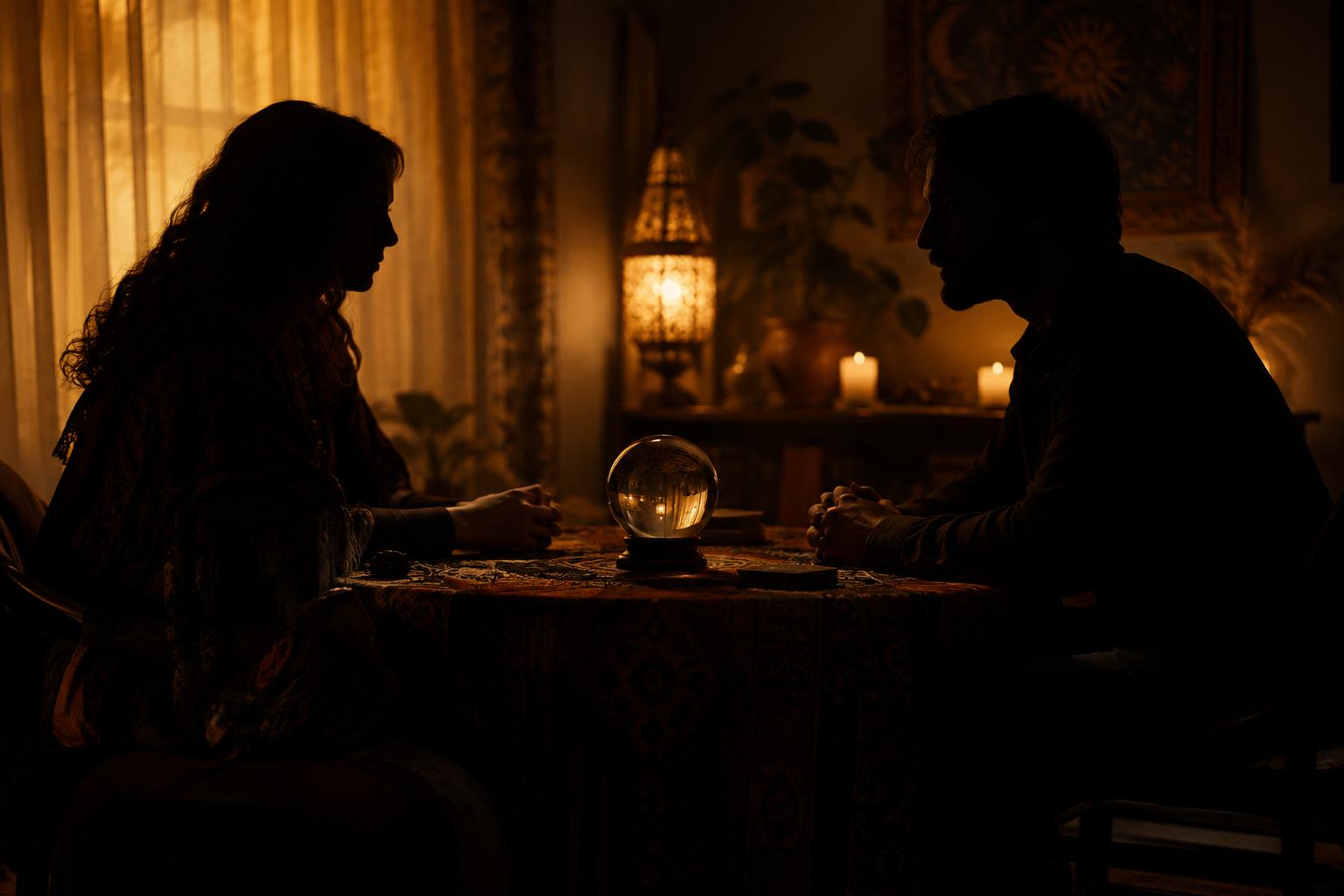
A typical clairvoyant session begins with a brief introduction and a question or topic from the client. Some readers prefer minimal background information so they can respond with what they believe comes through naturally. Others welcome context because they say it helps them focus.
After that, the reader may settle into a quiet rhythm. They might describe images, colors, names, scenes, or unexpected flashes of insight. The client often responds with confirmation, clarification, or questions, which can shape the rest of the conversation.
In many cases, the session feels less like a performance and more like a guided dialogue. The tone can be practical, comforting, or highly symbolic depending on the style of the reader. No two sessions are identical, which is one reason people leave with such different impressions of the same kind of service.
Common elements clients report hearing
- Insight into relationships and communication patterns
- General guidance about decisions and timing
- Descriptions of emotional or spiritual blocks
- Messages the reader says relate to loved ones or past experiences
- Suggestions for reflection, grounding, or next steps
That list is broad because the field itself is broad. Some readers stick to very general themes, while others make more detailed observations. The range can be part of the appeal, but it also means clients need to listen carefully to what is actually being said, not just what they hope to hear.
Why people seek this kind of reading
There is no single reason people book a clairvoyant reading. One client may want reassurance before a major move, while another is trying to understand a repeated pattern in relationships. Some people arrive during a rough patch and want a space where their worries are taken seriously without being dismissed.
For many, the attraction is the promise of attention. A good reader listens closely and speaks directly to the concerns a person brings into the room. Even when the client remains skeptical, that focused attention can feel meaningful in itself.
Others are drawn to the possibility of uncovering something they have overlooked. The appeal is not always about predicting the future. Sometimes it is about hearing a fresh interpretation of an old problem, especially when ordinary advice has started to feel stale.
If you want the practical side of how these sessions are structured, see common methods and session formats.
How claims are framed and why that matters
Clairvoyant reading claims vary widely. Some practitioners say they can identify emotional patterns, describe unseen influences, or sense likely developments. Others make softer claims, describing their work as interpretive and intuitive rather than predictive in a strict sense.
The difference between those approaches is not small. A reader who promises precision is asking for a different kind of trust than one who simply offers reflections and observations. That is why it pays to pay attention not just to the content of the reading, but to the framing around it.
The most responsible practitioners tend to avoid overpromising. They leave space for uncertainty and avoid telling clients that a single session can settle every question. That restraint does not make the reading less interesting; if anything, it can make the conversation more credible.
For a broader framework on judging those claims, see how to assess claims and testimonials.
The emotional side of the experience
A lot of the power people describe in clairvoyant readings has less to do with spectacle than with emotion. Being heard carefully, especially during a stressful period, can create a strong sense of relief. That can happen even if the client remains unsure about the source of the reader’s insight.
There is also the matter of timing. A comment that would seem vague on a random Tuesday can land very differently when someone is facing a breakup, a move, or a career change. The same sentence can feel either thin or piercing depending on what the client is carrying into the room.
People often leave intuitive sessions less interested in whether the reading was “right” than in whether it helped them think more clearly. That distinction is useful. Sometimes the value lies in the pause the session creates, not in any single prediction.
Different styles among readers
Not every clairvoyant reader works in the same way. Some rely on live conversation, some use photos or names, and some work in quiet bursts with little interruption. A few are highly descriptive and emotional; others are restrained and matter-of-fact.
There are readers who treat their work almost like counseling, focusing on self-awareness and personal choice. Others emphasize symbolism, spiritual themes, or messages from beyond the ordinary senses. Those differences shape the tone of the session as much as the content does.
That variety can be helpful if you know what you want. A person seeking comfort may prefer a warmer style, while someone looking for blunt feedback may want a more direct approach. The wrong match can feel frustrating, even if the practitioner is skilled in their own way.
Questions people often bring to a session
- Is this relationship moving in the right direction?
- Should I stay where I am or make a change?
- Why do I keep running into the same problem?
- What should I pay attention to right now?
- What am I missing about this situation?
Those questions are simple on the surface, but they often hide a larger need: reassurance, orientation, or a second opinion. A session works best when the question is honest rather than performative.
What to expect from a clairvoyant
People often search for what to expect from a clairvoyant because the experience can feel unfamiliar. The most realistic answer is that you should expect a mix of interpretation, suggestion, and conversation. You may hear statements that feel personal, broad, symbolic, or oddly specific.
You should also expect variation. One practitioner may be direct and concise, while another may spend time explaining how an image came to them. A session can be emotional, comforting, vague, or surprisingly practical depending on the reader’s style and the client’s openness.
It helps to remember that a reading is not the same thing as a diagnosis, a legal opinion, or a financial plan. Some clients treat it as a reflective tool rather than a source of hard answers. That approach often leads to a calmer, more useful experience.
A few practical ways to prepare
- Choose one or two topics instead of trying to cover everything at once.
- Notice whether the reader stays specific or drifts into vague statements.
- Pay attention to what resonates now and what may need time to make sense.
- Leave room for your own judgment rather than handing it all over to the reading.
That last point matters more than people sometimes admit. A reading can prompt useful reflection, but it should not replace common sense. The best use of the experience is often to test an idea against your own knowledge of your life.
What the service is not
It is worth saying plainly that a clairvoyant reading is not a substitute for medical care, legal advice, or financial planning. Some practitioners may discuss those areas in broad terms, but they are not replacements for trained professionals. That boundary should stay visible.
It is also not wise to treat a reading as a command. Even a very compelling session should be weighed against facts, practical judgment, and your own knowledge of the situation. The most thoughtful clients use the reading as one input, not the only one.
That approach keeps the experience in proportion. It allows room for curiosity without surrendering common sense. And it helps ensure that whatever value the session has comes from reflection, not from blind dependence.
Signs of a careful, grounded practitioner
People who offer clairvoyance services responsibly often share a few habits. They are careful with promises, respectful about sensitive topics, and willing to admit when something is unclear. They do not need to sound mystical every second to seem credible.
| Helpful sign | Why it matters |
|---|---|
| Clear language | Shows the reader can explain their process without hiding behind fluff |
| Respect for boundaries | Helps keep the session focused and ethical |
| No pressure to return immediately | Suggests the reader is not trying to create dependence |
| Willingness to say “I’m not sure” | Usually a better sign than grand certainty |
None of those traits guarantee anything supernatural or not. They simply suggest professionalism and restraint. In a field with plenty of room for ambiguity, that counts for a lot.
How to think about the results afterward

After a session, it helps to give yourself a little distance before deciding what it all meant. Some comments will land immediately. Others will make sense only after an event unfolds, or they may never feel relevant at all.
Sorting through the experience works best when you separate the useful from the theatrical. Ask yourself what was specific, what was vague, and what was simply memorable because of the moment. That kind of review keeps the reading from becoming larger than it needs to be.
If you are someone who likes to journal, jotting down the strongest points right after the session can be useful. Not because the notes prove anything, but because memory gets slippery fast. A few lines on paper can help you spot patterns later.
If you want a clearer framework for that kind of review, see how to find a reader you can trust.
The role of belief, expectation, and atmosphere
Atmosphere plays a bigger role than many people realize. The tone of voice, the pace of the session, even the room itself can shape how a message is received. A calm setting can make a person more receptive, while a rushed one can make everything feel thin.
Expectation matters too. Someone who arrives eager to believe may hear a statement very differently from someone who is determined to disprove it. Neither reaction is strange. They simply show that readings are experienced through human perception, not outside it.
That is one reason two people can attend similar sessions and walk away with opposite reactions. One may feel deeply seen, while the other hears little more than a collection of broad observations. The experience is part message, part mirror, and part interpretation. Skeptics often focus on the vagueness of some statements, the flexibility of interpretation, or the fact that broad guidance can seem meaningful to many different people. Those observations are fair. Still, skepticism does not have to turn into dismissal. A person can be cautious and still notice that a session prompted reflection. What keeps clairvoyant readings alive is not hard to understand. They offer a structured moment to ask serious questions and hear them answered in a way that feels personal. For some people, that is enough to make the experience worthwhile, whether they see it as spiritual, intuitive, or simply reflective. The most honest way to look at the practice is to notice both its promise and its limits. If the exchange leaves you clearer, steadier, or more aware of your own thinking, that may be the real offering. And if it does not, that too tells you something useful.